
high school anecdotes
true story!

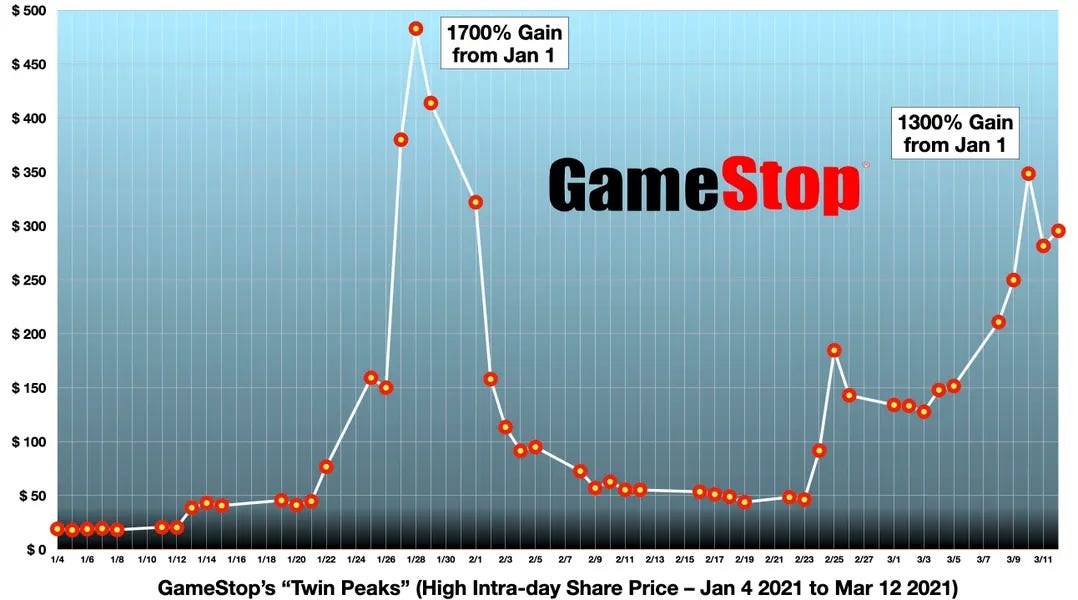
On one monitor I have the Google Meet for my physics class—nobody else has their camera on. On the other monitor, I have Gamestop’s stock price on Yahoo Finance. It was at $80 when I bought—now it’s at $120. Earlier it was at $180. I watch the price bounce up and down. It stresses me out to the point where I leave the Google Meet, turn my computer off, and lie down on the couch.
Every evening, after trading hours, I check the number of stocks sold short. It’s still more than the number of shares outstanding. I don’t sell. I’d find the whole thing more amusing if it wasn’t so stressful.
Later, when I move out to the Bay, I live off the couple thousand dollars I made from the whole experience.
It’s Saturday—my best friend D and my girlfriend are both supposed to come over for lunch with my parents. Unfortunately, I can’t reach my friend to confirm—his parents freaked out and took his phone away because people were talking about sex in a group chat he was in. My girlfriend is incredibly shy—without my friend there to take the attention off her, it’ll be a disaster.
He’s not responsive through GChat, and we didn’t confirm the time or the address. What can I do?
After about five minutes of googling, I find an address in our neighborhood under his dad’s name. It’s not far. I bike over, knock on the door, and ask if D is home. “Yeah, lemme grab him.” D comes down and sees me.
“How do you know where I live?”
“Internet.”
“Yeah, alright.”
When my girlfriend arrives, she apologizes for being late—my dad jokingly asks “how many houses did you visit before ours by accident?”
D and I look at each other and don’t say anything. She answers, deeply embarrassed, “...two.” My dad immediately goes red and apologizes, while D and I bust up laughing. She had texted me after the second house to confirm our address, but I didn’t want to spoil the fun by mentioning that.
“Ms. N, do you think forcing me to be here is a reasonable use of the state monopoly on violence?”
“Yes.”
“...okay.”
Our school’s switching from purely remote learning to hybrid—some students are coming in-person, some are staying online. I’m one of three people physically at my Latin class.
The teacher calls me out for not paying attention—I’m reading a Scott Alexander article on my laptop. I apologize, and move my head to face the projector.
“You know, I can see that your eyes are still looking at the laptop.”
I take a pair of sunglasses out of my backpack, put them on, and continue reading while facing the board. He doesn’t say anything else.
In sophomore year, I read Bryan Caplan’s The Case Against Education. I find it quite interesting, and attempt to talk about it with my teachers. They aren’t that interested.
I send Bryan an email telling him I enjoyed the book. A couple minutes later, I hear back from him—he invites me to lunch with him! My mom drives me over, and I recognize (and freak out a little bit over) Robin Hanson there as well, along with somebody I don’t recognize. I greet him and Robin. “And are you Alex Tabarrok?”
“No, this is my teenage son.”
“Oh.”